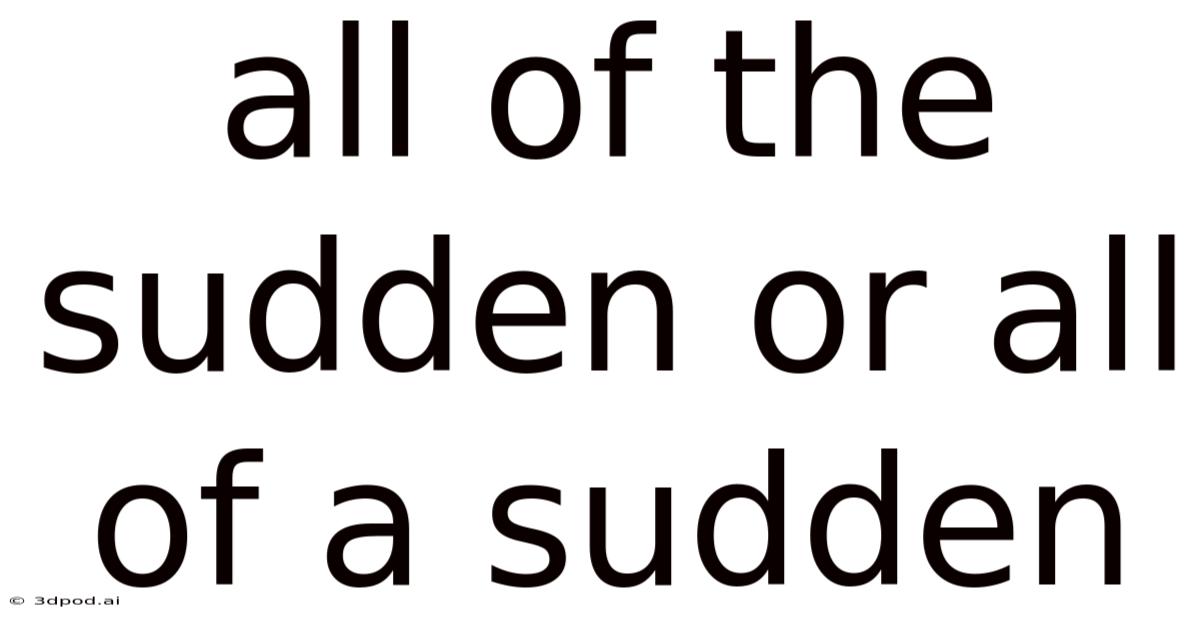
The phrase “all of a sudden” is a common idiom used to describe something that happens unexpectedly, while “all of the sudden” is a frequent mistake that can undermine clarity. Even so, understanding the correct usage, the grammatical reasoning behind the expression, and the subtle differences in meaning will help you communicate more precisely in both spoken and written English. This article explores the definition, proper application, historical background, and practical tips for mastering this everyday phrase.
Definition and Meaning
Idiomatic Sense
All of a sudden functions as an idiom that signals an abrupt or unexpected change in circumstances. It emphasizes the suddenness of an event, often implying that the occurrence took the speaker or listener off guard. Here's one way to look at it: “The lights went all of a sudden out during the concert.”
Grammatical Structure
The phrase follows a noun phrase pattern: all (determiner) + of (preposition) + a (indefinite article) + sudden (adjective). The combination creates a noun phrase that modifies verbs, adjectives, or entire clauses. Because sudden is an adjective, it does not require a definite article (the) when it is part of this fixed expression Still holds up..
Common Misuse
“All of the Sudden” – Why It’s Incorrect
Many learners mistakenly insert the before sudden, likely because they treat the phrase as a noun phrase rather than an idiom. Even so, sudden here functions as an adjective, not a noun, so adding the is grammatically inappropriate. While some informal contexts may tolerate the error, formal writing and academic settings demand the correct form The details matter here..
Frequency in Media
A quick search of news articles, textbooks, and social media reveals that “all of the sudden” appears far less often than “all of a sudden”. The correct version dominates professional and educational content, reinforcing its status as the standard form.
How to Use the Phrase Correctly
Typical Sentence Patterns
- At the beginning of a clause
- All of a sudden, the sky turned dark.
- Mid-sentence for emphasis
- We were enjoying the concert when, all of a sudden, the power went out.
- As a parenthetical remark
- She laughed nervously; all of a sudden, she started crying.
Real‑life Examples
- All of a sudden, my phone battery died right before the meeting.
- The car all of a sudden stopped without warning.
- All of a sudden, everyone in the room fell silent.
These examples illustrate how the phrase smoothly integrates into narrative flow, highlighting an unexpected shift.
Why It Works: The Grammar Behind the Phrase
Idiomatic Nature
Idioms often defy strict grammatical rules because they are frozen expressions that have become conventionalized over time. All of a sudden is one such frozen form; its internal structure does not follow the typical pattern of “all of the sudden” because sudden remains an adjective, not a noun No workaround needed..
Historical Origin
The phrase traces back to Middle English and early Modern English usage, where sudden originally meant “unexpected” or “abrupt.” Over centuries, the construction all of a sudden solidified as the standard way to make clear unexpectedness. Early writers such as John Milton and William Shakespeare employed similar constructions, cementing the idiom in the language.
Comparison with Similar Expressions
- All of a sudden ≈ suddenly (adverb)
- All of a sudden ≈ all of a quick (archaic)
While suddenly is an adverb and can modify verbs directly, all of a sudden functions as a noun phrase that can be placed at the start, middle, or end of a clause for stylistic effect.
Practical Tips for Learners
Step‑by‑step Guide to Choose the Right Form
- Identify the intended meaning – Do you want to stress unexpectedness? Use all of a sudden.
- Check the grammatical role – Is sudden acting as an adjective? No article is needed.
- Consider the context – Formal writing demands the correct idiom; informal speech may tolerate errors but clarity is still key.
- Practice placement – Try inserting the phrase at the beginning, middle, and end of a sentence to see which feels most natural.
Practice Exercises
- Rewrite the following sentences using all of a sudden correctly:
- “The power went the sudden and everyone was confused.”
- “All of a sudden the dog started barking.” (already correct)
- “The lights went the sudden out during the movie.”
- Create five original sentences that incorporate the phrase in different positions (initial, medial, final).
Common Pitfalls to Avoid
- Overusing the phrase – While effective, excessive use can sound repetitive.
- Mixing with “suddenly” – Ensure you choose the idiom when you need a noun phrase, and use suddenly when an adverbial modification suffices.
- Ignoring punctuation – A comma after the phrase often improves readability, especially when it appears mid‑sentence.
Frequently Asked Questions (FAQ)
Q1: Is “all of the sudden” ever correct?
A1: In standard English, “all of the sudden” is considered incorrect because sudden functions as an adjective, not a noun. That said, some informal contexts (e.g., casual speech) may accept the error, but for academic or professional writing, stick with “all of a sudden.”
Q2: When to use “all of a sudden”?
A2: Use it whenever you need to underline an unexpected or abrupt change. It works well in narratives, descriptive paragraphs, and conversational contexts.
Q3: Can it be used in formal writing?
A3: Yes, the idiom is perfectly acceptable in formal writing as long as it is used correctly. It adds a vivid, concise way to describe sudden events without sacrificing clarity Worth keeping that in mind. That alone is useful..
Q4: How does
Q4: How does "all of a sudden" differ from "suddenly" in terms of impact?
A4: The primary difference lies in grammatical function and stylistic nuance. Suddenly is a straightforward adverb that modifies the verb directly (e.g., "The rain started suddenly"). All of a sudden, as a noun phrase, carries more narrative weight. It often signals a dramatic shift in a story, making the unexpected event feel more abrupt and noteworthy. Think of suddenly as a simple fact, while all of a sudden is a dramatic plot point.
Q5: Are there other similar idiomatic expressions?
A5: Yes, English is rich with such expressions. Other examples include:
- "All of a piece": Meaning "completely" or "altogether" (e.g., "He jumped all of a piece with fright").
- "All of a heap": An archaic phrase meaning "in a tangled or confused state." On the flip side, all of a sudden remains the most common and versatile for describing unexpected events.
Conclusion
Mastering the phrase "all of a sudden" is a small but significant step toward achieving fluency and naturalness in English. In real terms, it is a testament to how language thrives on idiomatic expressions that go beyond strict grammar to convey nuance and emotion. Plus, by understanding its correct form, strategic placement, and the distinction from the more clinical "suddenly," you can add a layer of vividness and authenticity to your speech and writing. But remember, it is not merely a phrase to be memorized, but a tool to be wielded for creating emphasis, building suspense, and painting a more compelling picture of sudden change. Its proper use signals a deep familiarity with the rhythms and textures of the English language That alone is useful..
Beyond the Basics: Using “All of a Sudden” in Advanced Contexts
1. Literary and Narrative Power
In fiction and creative nonfiction, all of a sudden functions as a narrative catalyst. It signals a turning point that the reader can feel viscerally, rather than merely intellectualizing the shift.
Example (short story snippet):
The lighthouse keeper had tended the lamp for decades, its rhythmic beam a constant in his life. All of a sudden, the sky blackened, and a wind so fierce it rattled the glass panes slammed against the stone walls.
Notice how the phrase creates a pause, heightening anticipation before the storm arrives.
2. Academic and Formal Prose
Even in scholarly writing, the idiom can be a stylistic device to highlight an unexpected discovery or a paradigm shift.
Example (research context):
Previous models assumed a gradual increase in atmospheric CO₂ levels. All of a sudden, the ice core samples revealed a sharp spike dating to 1850, challenging long‑held assumptions.
Here, the phrase underscores the abruptness of the data’s revelation without sacrificing academic rigor Small thing, real impact. And it works..
3. Spoken English: Conversational Nuance
In everyday conversation, all of a sudden often carries an emotional charge, reflecting surprise, shock, or even humor Easy to understand, harder to ignore. Which is the point..
Example (dialogue):
I was walking to work, minding my own business, when all of a sudden a dog bolted out from between the trees and stole my sandwich.
The phrase helps listeners gauge the intensity of the speaker’s reaction Less friction, more output..
4. Common Pitfalls and How to Avoid Them
| Pitfall | Why It Happens | How to Fix It |
|---|---|---|
| Mixing up “sudden” and “abrupt” | Both words describe quickness, but all of a sudden specifically denotes an unexpected shift, while “abrupt” can apply to any sudden end or beginning. , “He arrived, all of a sudden, late”). g. | Place it at the start of a clause or after the subject for clarity: “All of a sudden, he arrived late. |
| Confusing with “all of a piece” | The latter means “as a whole,” not “suddenly.Worth adding: ” | |
| Incorrect placement | Inserting the phrase mid‑sentence can break flow (e. ” | |
| Overusing the idiom | Writers sometimes rely on it as a default for any change, diluting its impact. ” | Verify the intended meaning; use “all of a piece” only when completeness is the focus. |
5. Mini‑Exercise: Choose the Right Phrase
Read each sentence and decide whether all of a sudden or suddenly fits best.
- ___ the power went out during the concert, leaving the audience in darkness.
- ___ the researcher discovered a flaw in the methodology, prompting a complete redesign.
- ___ the cat slipped from the windowsill and landed on the floor.
- ___ the crowd erupted in applause after the finale.
Answer Key (for self‑checking):
- Suddenly
- All of a sudden
- Suddenly
- All of a sudden
6. Further Resources
- Style Guides: The Chicago Manual of Style and the APA Publication Manual both list all of a sudden as the idiomatic form, recommending sudden as the adjective.
- ** corpora:** The Corpus of Contemporary American
7. Stylistic Implications for Academic Writing
While the idiom all of a sudden enriches narrative prose, its frequent overuse can obscure precision. Academic papers, technical reports, and journalistic articles therefore benefit from a disciplined approach to its deployment.
-
Clarity first. When the goal is to convey a temporal shift that is itself noteworthy—such as a rapid methodological breakthrough—all of a sudden works well because it signals importance. In contrast, if the change merely marks a brief interruption (e.g., a pause in speech), suddenly suffices without risking ambiguity Simple, but easy to overlook..
-
Parallelism matters. A sentence that mixes two different temporal markers can become muddled. Consider the revised version below:
“After weeks of meticulous testing, the team observed a dramatic improvement in efficiency, all of a sudden, suggesting that the new algorithm had unlocked hidden performance gains.”
Here, all of a sudden correctly emphasizes the surprising nature of the result, whereas swapping it for suddenly would diminish the rhetorical effect Which is the point..
-
Avoid redundancy. If you have already introduced a synonym earlier in the paragraph (for instance, “abruptly”), inserting another variant may read as redundant. Opt for a single anchor point per sentence.
8. Cross‑Cultural Considerations
Linguistic study reveals that speakers of certain languages may interpret all of a sudden differently depending on context. Non‑native speakers learning English often mistakenly translate sudden as the full idiom, leading them to insert all of a sudden where a simple adverb would suffice. In British English, the phrase is common in colloquial storytelling, whereas American academic writing tends to favor suddenly. Providing explicit translation notes in multilingual textbooks can help mitigate this confusion.
9. Practical Exercise for Editors
When reviewing a manuscript, editors should perform a quick scan for instances of all of a sudden. The following checklist can streamline the process:
- Identify the clause containing the phrase.
- Ask: Is the event truly unexpected?
- Yes → Keep all of a sudden (or suddenly if brevity is preferred).
- No → Replace with suddenly, abruptly, or a more precise adverb.
- Check surrounding punctuation. Ensure the phrase stands alone or follows a clear syntactic boundary; avoid embedding it mid‑clause unless the emphasis demands it.
- Verify consistency across the document to maintain stylistic cohesion.
By applying these steps, editors can preserve the vividness of sudden events while upholding scholarly standards.
10. Summary
Across scientific reporting, literary narration, and everyday dialogue, the expression all of a sudden serves as a powerful tool for highlighting spontaneity and surprise. Which means its strengths lie in immediacy and emotional resonance, yet they come with caveats regarding frequency and appropriateness. Think about it: by distinguishing when it adds genuine insight—and when a simpler adverb fulfills the same function—writers can wield the phrase responsibly. Conversely, being mindful of pitfalls such as misuse, over‑application, and cross‑linguistic misinterpretation ensures that the idiom enhances rather than distracts from communication.
And yeah — that's actually more nuanced than it sounds.
In sum, mastering the subtle differences between all of a sudden and suddenly equips authors with a nuanced palette for describing change, whether the story unfolds in a laboratory report, a news article, or a casual chat. Day to day, the key is intentionality: choose the word that best mirrors the weight of the moment you wish to convey. This deliberate selection not only sharpens your prose but also aligns it with the expectations of diverse audiences—academic peers, professional readers, and native‑speaker listeners alike Practical, not theoretical..
