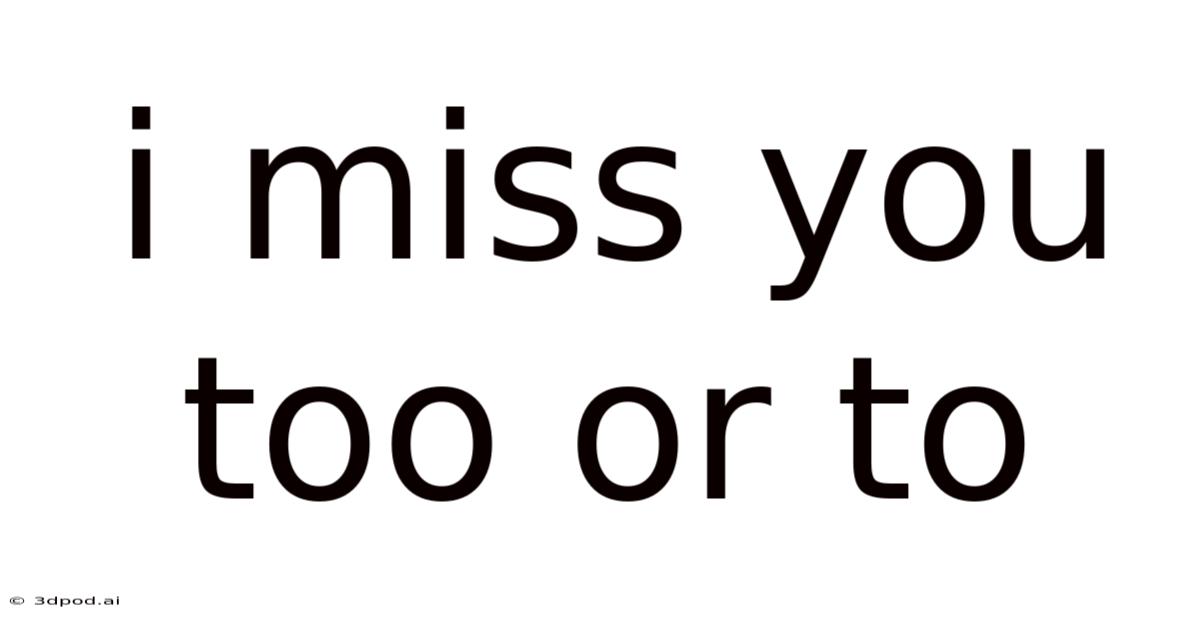
The phrase "I miss you" carries a weight that few other three-word sentences can match. It bridges distance, soothes loneliness, and reaffirms bonds. But when the reply comes—or when you are the one formulating that reply—a tiny grammatical fork appears in the road: too or to?
If you have ever stared at your screen, thumb hovering over the keyboard, wondering which three-letter word completes the thought correctly, you are not alone. Think about it: this is one of the most common stumbling blocks in English writing, precisely because the two words sound identical. They are homophones—words that share pronunciation but differ in meaning, spelling, and grammatical function.
The short answer is definitive: The correct phrase is "I miss you too."
On the flip side, understanding why "too" wins and "to" loses transforms this from a memorization task into an intuitive grasp of English mechanics. Let’s unpack the grammar, the nuance, and the contexts so you never have to second-guess this again.
The Core Difference: Adverb vs. Preposition
To master this distinction, we must look at the "jobs" these words perform in a sentence.
Too (The Adverb of Addition)
Too functions as an adverb. Its primary roles are:
- Meaning "also," "as well," or "in addition."
- Meaning "excessively" or "to an undesirable degree" (e.g., "It is too hot").
In the sentence "I miss you too," the word signals reciprocity. It says: *The feeling you just expressed? In practice, i hold that exact same feeling. * It mirrors the subject Easy to understand, harder to ignore..
- "I love this song." → "I love it too.That's why " (I love it also. )
- "She is coming to the party." → "He is coming too." (He is coming as well.
To (The Preposition and Infinitive Marker)
To is a workhorse preposition and a particle used to form infinitives. It indicates direction, destination, relationship, or purpose. It never means "also."
- Direction/Destination: "I am going to the store."
- Recipient: "Give this to her."
- Infinitive Verb: "I want to go home."
- Time/Range: "Nine to five."
Why "I Miss You To" Is Grammatically Impossible
When you write "I miss you to," you are attempting to use a preposition where an adverb is required. Let’s test the logic:
- Does "to" indicate direction? No, you aren't missing someone toward a location.
- Does it indicate a recipient? No.
- Is it part of an infinitive verb? The verb here is "miss." "To miss" is the infinitive form, but the sentence is conjugated ("I miss"). You cannot say "I to miss you."
The only scenario where "to" appears near "miss you" is in a completely different sentence structure, such as:
- "I want to miss you.Because of that, " (Infinitive — though semantically odd). > * "It hurts to miss you." (Infinitive phrase acting as subject).
But as a standalone response? "I miss you to" is always incorrect.
The "Also" Substitution Test
The fastest way to verify the correct spelling in real-time is the Substitution Test.
Can you replace the word with "also" or "as well" and have the sentence make perfect sense?
- "I miss you also." ✅ (Makes sense. Use too.)
- "I miss you as well." ✅ (Makes sense. Use too.)
- "I miss you excessively." ✅ (Contextually possible, though dramatic. Use too.)
Now try the "to" definitions:
- "I miss you toward." ❌
- "I miss you in order to." ❌
If "also" fits, too (with two 'o's) is your word. Think of the extra 'o' as representing the extra person feeling the same way—one 'o' for you, one 'o' for me.
Nuance and Tone: Beyond Basic Grammar
While "I miss you too" is the standard, grammatically correct response, language is alive. The way you say it changes the emotional texture.
1. The Standard Reciprocal: "I miss you too."
Neutral, warm, complete. It closes the loop.
Friend: "Safe travels! Miss you already." You: "Thanks! I miss you too."
2. The Emphatic "Also": "I miss you, too."
Adding a comma before "too" (per formal style guides like Chicago Manual of Style) creates a slight pause. It emphasizes the addition.
Partner: "I miss you terribly." You: "I miss you*, too**." (Feels heavier, more deliberate.)*
3. The Intensifier: "I miss you so much, too."
"Too" handles the reciprocity; "so much" handles the magnitude.
4. The "Excessive" Too (Rare but Poetic)
"I miss you too much." Here, the second definition of "too" (excessively) takes center stage. It implies the missing is painful, disruptive, or overwhelming. This isn't just reciprocity; it's a confession of vulnerability.
Common Pitfalls and "False Friends"
Learners often confuse "too" and "to" because of phonetic reduction. " "Too" retains its full vowel sound (/tuː/). On the flip side, * Spoken: "I wanna go tuh the park. In rapid speech, "to" often weakens to a schwa sound (/tə/), sounding like "tuh." (To)
- Spoken: "I wanna go too." (Too — distinct long 'oo' sound).
In writing, however, the distinction is rigid. Another common error is confusing two (the number 2). On the flip side, * Incorrect: "The two of us miss you to. "
- Correct: "The two of us miss you too.
Real-World Contexts: Texting, Email, and Formal Writing
Casual Texting / DMs
Brevity rules. "Miss u 2" or "Miss u too" are standard. Grammar prescriptivism takes a backseat to speed, but "too" remains the correct spelling if you are typing words out. "Miss u to" looks like a typo to a native speaker It's one of those things that adds up..
Professional Email
If a colleague says, "Great working with you. I'll miss you when you leave," your reply should be polished:
"The feeling is mutual; I will miss you too." (Or "I shall miss you as well" for high formality) Small thing, real impact..
Creative Writing / Dialogue
Authors use the "too" vs. "to" distinction to characterize.
- Educated character: "I miss you, too."
- Character with limited literacy (shown via eye dialect): "I miss you to." (This signals the character's education level to the reader without narration).
The "Me Too" vs. "I Too" Sidebar
A related grammatical trap appears when the subject changes.
- Correct: "I miss you." → "Me too.
…because the verb “miss” is understood but not spoken. In this elliptical reply, the object pronoun “me” naturally follows the implied verb, mirroring the structure of the original statement: “I miss you” → “[I miss you] me too.”
When “I too” Sounds Correct (and When It Doesn’t)
In formal writing or when you want to keep the subject explicit, you can expand the ellipsis fully:
- I miss you, too. → I too miss you.
Notice the shift in word order: the adverb “too” now modifies the verb “miss” directly, and the subject “I” appears before it. This construction is grammatically sound but tends to feel stilted in everyday conversation. It works best in:
- Academic or legal texts where precision is prized:
“The defendant testified that he, too, was unaware of the clause.” - Poetic or rhetorical phrasing where a balanced rhythm is desired:
“She sang, and I too sang, though my voice trembled.”
In casual speech, however, “I too” often sounds overly deliberate or even archaic. Native speakers typically prefer the object‑pronoun version (“Me too”) or the full reciprocal (“I miss you, too”) because they flow more naturally with the cadence of English.
Avoiding the “I Too” Pitfall in Replies
A common mistake is to over‑apply the subject‑pronoun form when the original sentence already contains a subject:
- Incorrect:
Friend: “I miss you.”
You: “I too.” (Missing the verb; sounds fragmented.) - Correct alternatives:
You: “Me too.” (Elliptical, idiomatic.)
You: “I miss you, too.” (Full reciprocal.)
If you wish to keep the subject explicit while still being concise, you can retain the verb and drop the object:
- “I miss you too.” (Here “too” follows the verb, preserving the subject‑verb‑adverb order without sounding stiff.)
Quick Reference Cheat‑Sheet
| Situation | Preferred Reply | Why |
|---|---|---|
| Casual chat, texting | Me too / Miss u too | Mirrors spoken ellipsis; fast and natural |
| Polite workplace email | I will miss you too | Full reciprocal, maintains professionalism |
| Formal essay or report | I, too, miss you (or I too miss you) | Keeps subject explicit; adverb placement follows style guides |
| Literary dialogue showing erudition | I, too, miss you | Signals careful, educated speech |
| Dialect or character‑specific speech showing limited education | I miss you to | Eye‑dialect marks non‑standard usage for effect |
Wrapping Up
The tiny word “too” carries a surprising amount of nuance. By recognizing the elliptical power of Me too, the balanced weight of I miss you, too, and the stylistic options of I too or I, too, you can match your reply precisely to the tone and context of the conversation. Think about it: whether it signals simple reciprocity, adds emphasis, or even flips into the meaning of “excessively,” its placement—and the surrounding pronouns—shapes how sincere, formal, or colloquial your response feels. Choose wisely, and your words will convey not just that you miss someone, but exactly how you wish that sentiment to be heard Less friction, more output..
