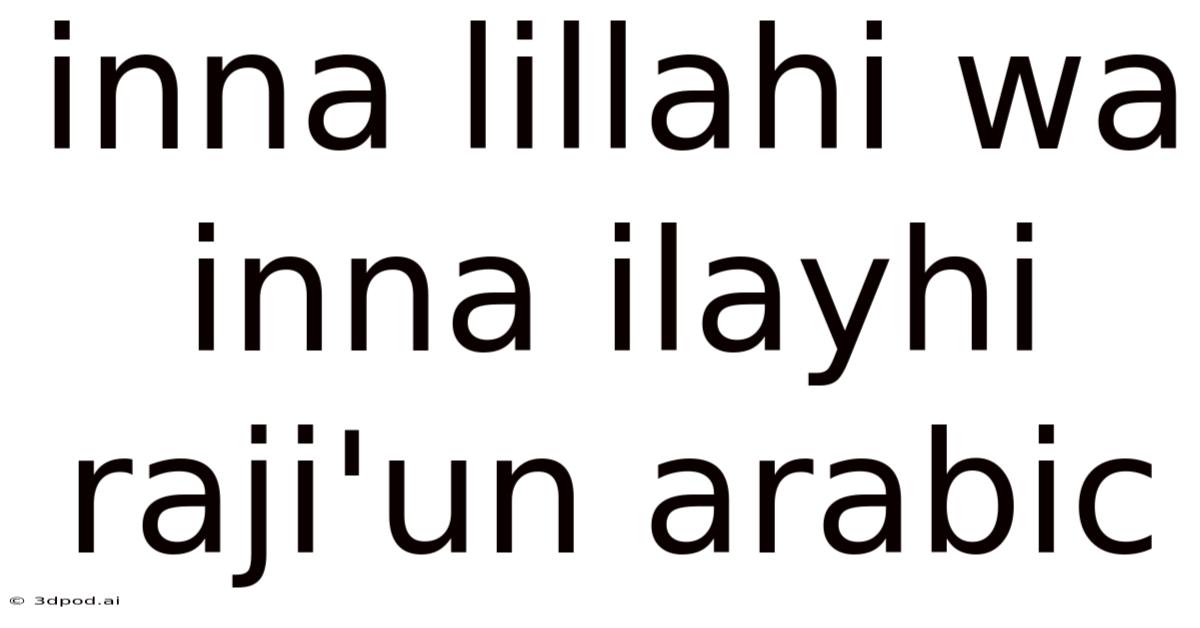
There is perhaps no phrase in the Arabic language more profound, resonant, and universally recognized than Inna lillahi wa inna ilayhi raji'un. Often translated as "Indeed, to Allah we belong and indeed to Him we will return," this simple yet powerful declaration carries immense weight in the hearts of Muslims worldwide. It is a statement of absolute submission, a reminder of the temporary nature of worldly existence, and a declaration of ultimate reliance on the Divine. Whether spoken at the time of a loved one’s passing, during moments of deep reflection, or as a daily affirmation of faith, this Arabic phrase serves as a spiritual anchor, guiding believers toward inner peace and a stronger connection with their Creator.
The Arabic Phrase and Its Literal Translation
To truly appreciate the beauty of this phrase, one must understand its linguistic roots. The word Inna (إنَّ) is an emphiric particle that conveys certainty and emphasis. It is used to introduce a profound truth or a firm declaration. The word Lillahi (لله) means "to Allah," indicating the ultimate source of origin and belonging. The conjunction Wa (و) means "and," serving to connect two parallel but equally vital truths. The second Inna mirrors the first, carrying the same weight of certainty. Ilayhi (إليه) translates to "to Him," pointing to the destination of return. Finally, Raji'un (رجعون) means "returning," emphasizing the cyclical nature of existence and the certainty of the Hereafter.
Historical and Scriptural Foundations
The phrase is deeply rooted in Islamic scripture, with its origins traceable to the Quran. It appears in Surah Al-Baqarah (2:156), where Prophet Muhammad’s (peace be upon him) own family is comforted with these words following the death of his son Ibrahim. The verse reads: “Nay, you will not succeed unless you are steadfast in prayer and expend charitable gifts, and do not cause grief to your people nor turn your face away from them in the gathering place.” The immediate context of the verse underscores the phrase’s role as a source of solace and resilience. Similarly, in Surah Al-Kahf (18:110), it is invoked as a reminder of the transient nature of life, reinforcing its place as a cornerstone of Quranic wisdom.
The phrase’s resonance extends beyond scripture into the lived experiences of Muslims. Still, it is frequently recited during times of loss, as a collective expression of mourning, yet its application is not limited to such solemn moments. Here's the thing — it permeates daily life, whispered during personal reflections, recited in moments of hardship, and even used as a casual reminder to maintain perspective on the fleeting nature of worldly pursuits. Its universality transcends cultural and geographical boundaries, uniting Muslims in a shared language of faith and humility.
This is the bit that actually matters in practice.
Theological and Spiritual Dimensions
Theologically, the phrase encapsulates core Islamic principles. It reflects tawhid (the oneness of God), affirming that all existence ultimately belongs to Allah, the Almighty and Omnipotent. The declaration also embodies taqwa (God-consciousness), urging believers to live with an awareness of their Creator’s omnipresence and their eventual return to Him. By repeatedly acknowledging their dependence on the Divine, Muslims cultivate a sense of submission (islam) and surrender (taslim), key tenets of their faith No workaround needed..
Spiritually, the phrase serves as a mirror for self-reflection. That said, each utterance invites believers to reassess their priorities, stripping away the illusions of permanence and materialism. It fosters khushu (humility before God) and tawakkul (reliance on divine decree), virtues that are cultivated through its mindful repetition. Scholars have noted that the phrase’s rhythmic cadence and profound meaning make it an ideal dhikr (remembrance of God), capable of soothing the soul and anchoring the heart in divine truth Worth knowing..
Cultural and Communal Significance
Beyond its individual impact, the phrase plays a vital role in communal life. It is often recited collectively at funerals, in mosques, and during communal prayers, creating a shared moment of unity and collective reliance on Allah. In diverse Muslim societies, it transcends linguistic barriers, serving as a universal identifier of faith. Even non-Muslims familiar with Islamic traditions recognize its power, often citing it as a poignant symbol of the religion’s emphasis on spiritual resilience and acceptance of divine will.
The phrase’s influence extends into literature, poetry, and popular culture. Poets and writers have woven its themes into their work, exploring its philosophical undertones and emotional depth. In modern times, it has been referenced in speeches, social media, and public discourse, often to express solidarity with victims of tragedy or to underscore the importance of faith in overcoming adversity Most people skip this — try not to..
Conclusion
"Inna lillahi wa inna ilayhi raji’un" is more than a phrase; it is a lifeline for the faithful, a compass guiding them through life’s uncertainties. Its enduring power lies in its ability to distill complex theological concepts into a single, accessible declaration, fostering a connection with the Divine that is both profound and practical
Beyond theology and culture, the phrase offers profound psychological resilience. This acceptance fosters inner peace, allowing individuals to work through life's inevitable hardships with grace and equanimity. It teaches believers that their struggles are not meaningless, but rather integral threads of a grand, divine tapestry. In times of grief or existential dread, the acknowledgment of shared return to Allah transforms individual sorrow into collective solace. The phrase thus acts as both a shield against despair and a beacon of hope, illuminating the path forward even in the darkest of times.
This dual capacity to console and uplift makes the phrase an enduring cornerstone of the human experience within the Islamic tradition, bridging the gap between the infinite promises of the Divine and the finite realities of human existence. When all is said and done, "Inna lillahi wa inna ilillahiraji’un" is not merely a statement of faith, but an active practice of living. It is the quiet anchor in the storm of
of uncertainty, grounding the believer in the certainty of divine wisdom and mercy. It reframes loss as a return, grief as a testament to love, and mortality as a passage rather than an end Simple, but easy to overlook..
In a world marked by fleeting attachments and unpredictable change, this declaration remains a spiritual compass. It reminds the faithful that while human life is temporary, the bond with the Divine is eternal. By embracing the reality of return, believers discover strength in surrender, peace in acceptance, and hope in the promise of reunion.
In essence, the phrase functions as a lifelong mantra, a reminder that every breath, every heartbeat, and every moment of joy or sorrow is woven into a larger tapestry of divine purpose. It invites believers to view each experience—not just loss or hardship—as an invitation to deepen their connection with the Creator, to practice gratitude in triumph and surrender in tribulation alike Not complicated — just consistent. Surprisingly effective..
When we internalize “Inna lillahi wa inna ilayhi raji’un,” we cultivate a resilient mindset that transforms adversity into opportunity for spiritual growth. We learn to work through the complexities of modern life with a sense of grounded certainty, knowing that our ultimate home lies beyond the temporal realms of this world. This perspective does not diminish the pain of loss; rather, it reframes it as a sacred passage, a temporary separation that strengthens our faith in the eternal reunion promised by Allah Not complicated — just consistent..
Thus, the phrase becomes more than a linguistic relic—it is a living practice that shapes character, nurtures community, and sustains hope. It equips individuals to face uncertainty with grace, to cherish fleeting moments with gratitude, and to anchor their lives in the unshakable truth that they belong to the Divine, and to Him alone. In this way, “Inna lillahi wa inna ilayhi raji’un” endures not merely as a phrase recited in moments of grief, but as a perpetual compass guiding every believer toward a life of purpose, peace, and profound connection Surprisingly effective..
