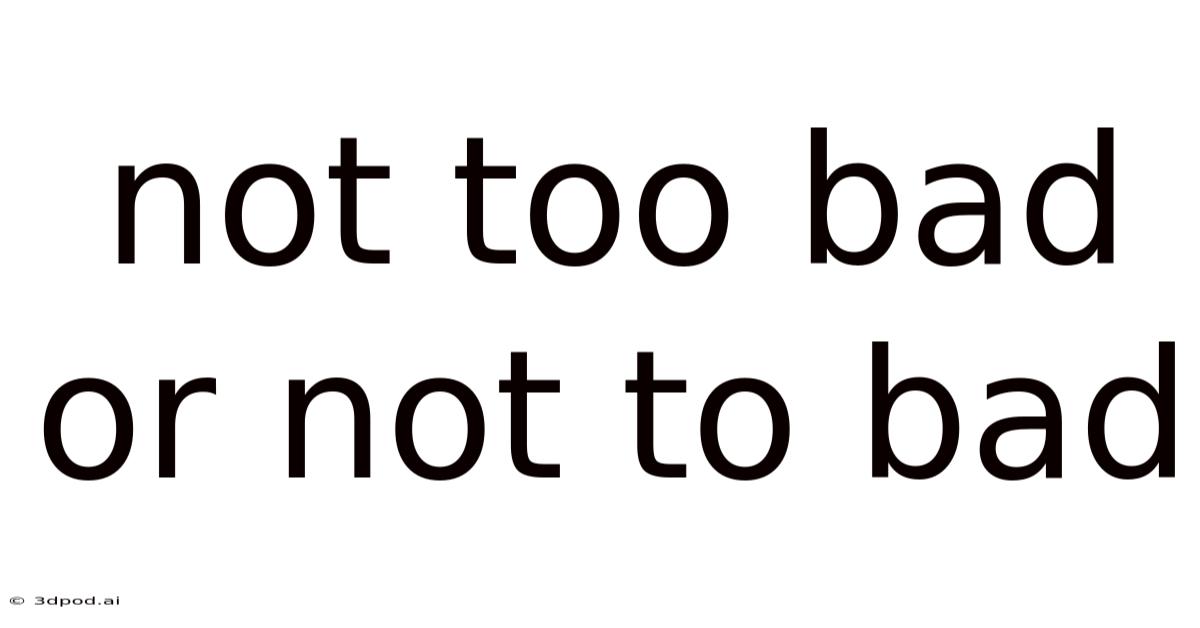
"Not too bad" is the correct standard English phrase used to express that something is satisfactory, reasonably good, or better than expected. Consider this: "Not to bad" is a common grammatical error resulting from the confusion between the adverb "too" (meaning excessively or very) and the preposition "to" (indicating direction or relationship). Understanding this distinction is essential for clear written communication, whether you are drafting a professional email, writing an academic paper, or simply texting a friend Worth keeping that in mind. That alone is useful..
The Grammatical Breakdown: Why "Too" Wins
To master this phrase, you must understand the parts of speech involved. So naturally, the word bad functions as an adjective in this construction. In English grammar, adjectives are typically modified by adverbs, not prepositions.
The Role of "Too"
Too is an adverb of degree. Its job is to modify adjectives (like bad, good, hot, cold) or other adverbs. It usually carries one of two meanings:
- Excessively: "The coffee is too hot to drink." (More than desired).
- Very / Extremely (Informal/Understatement): "The movie was not too bad." (Meaning: It was actually quite good).
In the phrase "not too bad," the adverb too modifies the adjective bad. The negation not flips the meaning from "excessively bad" to "moderately good" or "acceptable." This is a classic example of litotes, a figure of speech that uses understatement by negating the opposite of what is meant Most people skip this — try not to. But it adds up..
The Role of "To"
To is primarily a preposition (e.g., "I went to the store") or part of an infinitive verb form (e.g., "I want to eat"). It shows direction, destination, or relationship between words. It cannot modify an adjective Turns out it matters..
Writing "not to bad" is structurally similar to writing "not at bad" or "not for bad." It creates a syntactic dead end because a preposition requires an object (a noun or pronoun), but bad is an adjective. This is why "not to bad" is universally considered incorrect in standard English And that's really what it comes down to..
The Psychology Behind the Mistake: Homophones and Phonetics
If the rule is so clear, why is "not to bad" such a pervasive error? The answer lies in phonology—the study of speech sounds It's one of those things that adds up..
Identical Pronunciation
In almost all English dialects, too and to are homophones. They are pronounced exactly the same: /tuː/. When we speak, there is zero auditory difference between "not too bad" and "not to bad."
The "Schwa" Factor
In rapid, connected speech, the preposition to often reduces to a schwa sound (/tə/ or /tu/), sounding like "tuh."
- Spoken: "It's not tuh bad."
- Spoken: "It's not too bad."
Because the spoken forms are identical (or nearly identical), the brain relies on statistical probability when transcribing thought to text. The preposition to is one of the most frequent words in the English language. The brain's predictive text system often defaults to the high-frequency to rather than the lower-frequency adverb too, especially for writers who rely heavily on "ear" rather than grammatical analysis.
Visual Pattern Recognition
We see the pattern Verb + to + Verb (go to eat, want to go) infinitely more often than Not + too + Adjective. The neural pathway for "to" is deeply rutted; the pathway for "too" modifying an adjective is less traveled. This cognitive shortcut leads to the error That's the part that actually makes a difference. Which is the point..
Contextual Usage: When and How to Use "Not Too Bad"
"Not too bad" is an incredibly versatile idiom. Consider this: its meaning shifts subtly based on context, tone, and intonation. Mastering these nuances separates fluent speakers from textbook learners.
1. The Genuine Compliment (Positive)
"How was the new restaurant?" "Honestly? Not too bad. The pasta was excellent."
Here, it functions as a sincere, understated endorsement. That said, it implies "better than average" without hyperbolic enthusiasm. It is the linguistic equivalent of a solid 7.5/10 rating.
2. The Relief Response (Better Than Feared)
"Did you pass the audit?" "Not too bad. We had a few minor findings, but no major penalties."
In this context, the speaker expected a negative outcome. "Not too bad" signals relief. The baseline for comparison is "disaster," and the result cleared that low bar comfortably.
3. The "Damning with Faint Praise" (Lukewarm/Neutral)
"What did you think of the keynote speaker?" "Eh, not too bad."
A flat intonation, perhaps accompanied by a shrug, changes the meaning entirely. Here, it means "mediocre," "forgettable," or "just okay." It is polite indifference.
4. The Casual Greeting Response
"Hey, how’s it going?" "Not too bad, yourself?"
This is a phatic expression—language used for social bonding rather than conveying information. It is the standard, socially calibrated alternative to "Good" or "Fine." Saying "I am excellent" to a casual acquaintance can feel boastful; "Not too bad" maintains social equilibrium.
Common Collocations and Variations
To sound natural, learn the words that frequently surround this phrase.
| Collocation | Nuance |
|---|---|
| Not too bad at all | Emphasizes the positive; stronger endorsement. |
| Not too bad for a [beginner/first try/draft] | Qualified praise; acknowledges constraints. And |
| Not half bad | Idiomatic synonym; slightly more colloquial/enthusiastic. |
| Not so bad | Interchangeable; "so" feels slightly more conversational/spontaneous. |
| Could be worse | The cynical cousin of "not too bad"; focuses on the absence of catastrophe. |
No fluff here — just what actually works.
"Too" vs. "To" vs. "Two": The Triple Threat
Since we are discussing homophones, it is worth briefly securing the third member of the set: Two.
- Two (Number): "I have two apples."
- To (Preposition/Infinitive): "Give it to me." / "I want to sleep."
- Too (Adverb - Excess/Also): "It is too late." / "Me too."
Memory Aid (Mnemonic):
- Two has a W (like Twin or Twelve) $\rightarrow$ Number.
- To has one O $\rightarrow$ Points to one direction/goal.
- Too has two O's $\rightarrow$ Extra O's = Excessive / Also (adding an extra person).
Apply the mnemonic to our phrase: You need the "extra" O (too) because you are modifying the degree of "bad." You are adding emphasis.
Regional and Register Considerations
Formal vs. Informal Register
"Not too bad" is firmly informal to semi-formal.
- Acceptable: Team Slack channel, email to a close colleague, conversation with a professor during office hours, blog post, creative writing dialogue.
- Avoid: Formal academic thesis, legal contract, government policy document, keynote address to 5,000 people.
Formal Alternatives:
- "The results were satisfactory."
- "The performance was adequate.
