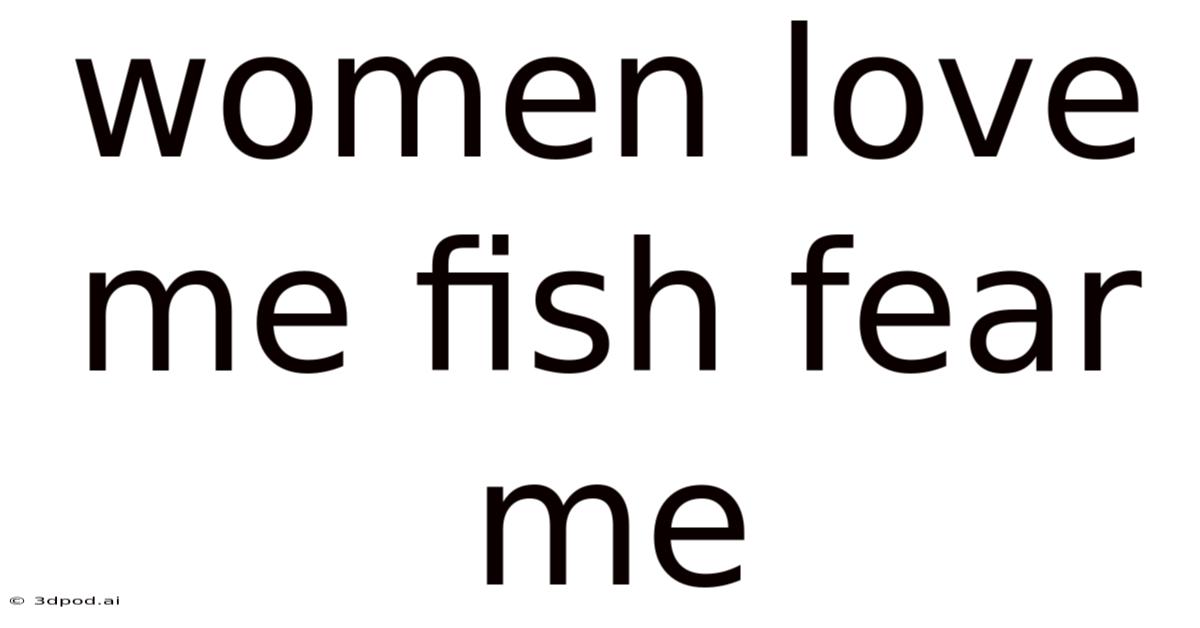
Women Love Me, Fish Fear Me: The Viral Meme Explained
The phrase "women love me, fish fear me" has become one of the most recognizable internet memes of recent years, transforming from a simple social media post into a cultural phenomenon that transcends age groups and online communities. This seemingly absurd statement combines human relationships with aquatic life in a way that captures both humor and existential absurdity, making it the perfect recipe for viral content in today's digital landscape.
The Origins of the Meme
The "women love me, fish fear me" meme traces its roots back to early 2020, when it first appeared on Twitter and other social media platforms. Practically speaking, the phrase gained initial traction through users who would post it alongside images of themselves in various poses – sometimes holding fish, sometimes not – creating an immediate visual contradiction that sparked curiosity and laughter. The meme's beauty lies in its perfect balance of confidence and ridiculousness, presenting a persona that commands respect from both romantic interests and sea creatures.
The earliest iterations often featured individuals posing with large fish they had supposedly caught, accompanied by captions claiming that women were naturally drawn to them while fish lived in constant fear of their presence. This created an absurd hierarchy where the poster positioned themselves as simultaneously charming to humans and threatening to aquatic life, a concept so ridiculous that it became genuinely entertaining Small thing, real impact..
You'll probably want to bookmark this section.
Why the Meme Resonates
The enduring popularity of "women love me, fish fear me" stems from several psychological factors that make it particularly appealing to internet users. First, the phrase embodies a form of exaggerated self-confidence that many people find amusing precisely because it's so over-the-top. In a world where social media often encourages modesty or self-deprecation, this meme represents the ultimate form of unchecked bravado.
Quick note before moving on.
Second, the meme taps into the human fascination with paradoxes and contradictions. The idea that someone could simultaneously be beloved by one group (women) while feared by another (fish) creates a cognitive dissonance that's both confusing and entertaining. This contradiction forces the brain to work slightly harder to process the information, which can make the experience more memorable and shareable And that's really what it comes down to. Took long enough..
Third, the meme provides a safe outlet for expressing confidence and masculinity without actually requiring the poster to be genuinely arrogant or offensive. It's a form of playful posturing that allows people to project an image of capability and charm while clearly signaling that they're being ironic Worth keeping that in mind..
Evolution Across Platforms
As the meme spread across different social media platforms, it evolved in fascinating ways. On TikTok, users began creating videos where they would dramatically reenact scenarios involving both romantic encounters and fishing expeditions, often using split-screen techniques to show themselves interacting with women on one side and fish on the other. These videos frequently incorporated trending audio clips and hashtags, helping to amplify the meme's reach That alone is useful..
Some disagree here. Fair enough The details matter here..
Instagram saw a different interpretation, with users posting aesthetic photos of themselves in outdoor settings – beaches, lakes, or simply posing with fishing equipment – while using the phrase as a caption. The visual component became crucial here, as users attempted to embody the confident, rugged persona suggested by the meme while maintaining an air of style and sophistication.
Reddit communities dedicated to the meme emerged, where users would share increasingly creative variations and discuss the philosophical implications of the statement. Some users began analyzing the deeper meaning behind the phrase, suggesting that it represented humanity's complex relationship with nature and our desire to assert dominance over our environment, even in absurd ways.
Cultural Impact and Variations
The meme's influence extended beyond social media into broader popular culture. Merchandise featuring the phrase began appearing on t-shirts, mugs, and other items, often marketed toward outdoor enthusiasts and anglers who appreciated the humorous take on fishing culture. The phrase even made its way into music lyrics and comedy routines, demonstrating its penetration into mainstream entertainment Turns out it matters..
Variations of the original meme began circulating, with users substituting different groups for "women" and "fish." Some popular versions included "dogs love me, cats fear me" or "children trust me, adults question me," each maintaining the core structure while exploring different aspects of social dynamics. These variations allowed the meme to remain fresh and relevant as the original version began to feel overused Practical, not theoretical..
The gaming community adopted their own version with "NPCs love me, bosses fear me," reflecting the meme's adaptability to different subcultures and interests. This flexibility has been key to the meme's longevity, as it can be easily modified to fit various contexts while maintaining its essential humorous premise.
The Psychology Behind the Humor
Understanding why "women love me, fish fear me" is funny requires examining the psychological mechanisms that drive humor in internet culture. Now, the meme employs what psychologists call "incongruity theory," where humor arises from the unexpected combination of incompatible elements. The juxtaposition of romantic success with aquatic intimidation creates a scenario that defies logical explanation, triggering laughter as the brain attempts to reconcile these contradictory ideas.
The meme also utilizes what's known as "hyperbolic humor," where exaggeration serves as the primary comedic device. By taking confidence to an absurd extreme and extending it to non-human animals, the phrase becomes inherently comical while still maintaining a kernel of relatable sentiment about wanting to be admired and respected Easy to understand, harder to ignore..
What's more, the meme benefits from what researchers call "benign violation theory," where something is considered funny when it simultaneously violates social norms while remaining harmless. Claiming to intimidate fish clearly violates expectations about appropriate behavior, but since no actual harm is implied toward the fish, the violation remains benign and therefore funny Most people skip this — try not to..
Modern Relevance and Legacy
Today, "women love me, fish fear me" continues to circulate in internet culture, though its peak popularity has waned. That said, its influence persists in how people approach self-presentation online and in the broader acceptance of absurdist humor in digital communication. The meme represents a moment in internet history where simple phrases could achieve massive cultural significance through pure viral momentum.
Its legacy can be seen in subsequent memes that employ similar structures of exaggerated confidence combined with unexpected elements. The phrase has become a reference point for understanding how internet culture develops and spreads, serving as a case study in viral content creation and community engagement.
Counterintuitive, but true.
For those who lived through its peak popularity, "women love me, fish fear me" remains a nostalgic reminder of simpler times in internet culture, when memes were often just clever phrases rather than complex multimedia productions. It stands as a testament to the power of simplicity and absurdity in creating lasting cultural phenomena that transcend their original context and continue to entertain new audiences long after their initial emergence It's one of those things that adds up..
The meme’s structure also invites playful reinterpretation, which has helped it linger in niche corners of the web. Users often swap the subjects—“cats adore me, routers dread me,” “bosses respect me, spreadsheets shudder at me”—creating a template that lets anyone project their own aspirational confidence onto absurdly specific audiences. This adaptability turns the original line into a linguistic sandbox, encouraging creativity while preserving the core joke: an over‑the‑top claim that is simultaneously brag‑worthy and delightfully nonsensical.
Beyond meme forums, the phrase has slipped into everyday banter as a shorthand for tongue‑in‑cheek self‑assurance. In gaming streams, a player might declare “women love me, fish fear me” after pulling off an improbable combo, using the line to signal both triumph and self‑aware humor. Similarly, motivational speakers have occasionally quoted it (with a wink) to illustrate how confidence can be reframed as a playful mindset rather than a solemn pledge, reminding audiences that a little levity can make lofty goals feel more approachable.
Academic interest in the meme has grown as well. Linguists point to its rhythmic parallelism—two clauses of equal length, each ending with a verb that conveys strong emotion—as a factor that makes it easy to remember and repeat. Sociologists note how the meme’s spread mirrored early‑2010s platforms where text‑based humor thrived before image‑heavy formats dominated, highlighting a shift in meme ecology from pure wordplay to multimedia remixes.
In retrospect, “women love me, fish fear me” exemplifies how a compact, absurd statement can capture the zeitgeist of a digital generation. So its endurance lies not in any deep philosophical insight but in its ability to let people laugh at the universal desire to be admired while acknowledging the silliness of taking that desire too literally. As internet culture continues to evolve, the meme remains a light‑hearted benchmark for measuring how confidence, humor, and the unexpected can intertwine to produce something that feels both timeless and distinctly of its moment Took long enough..
Conclusion: Though its viral peak has passed, “women love me, fish fear me” endures as a versatile joke template, a linguistic curiosity, and a nostalgic emblem of early meme culture—proof that sometimes the simplest, most ridiculous ideas leave the longest-lasting imprint on the way we communicate online.
