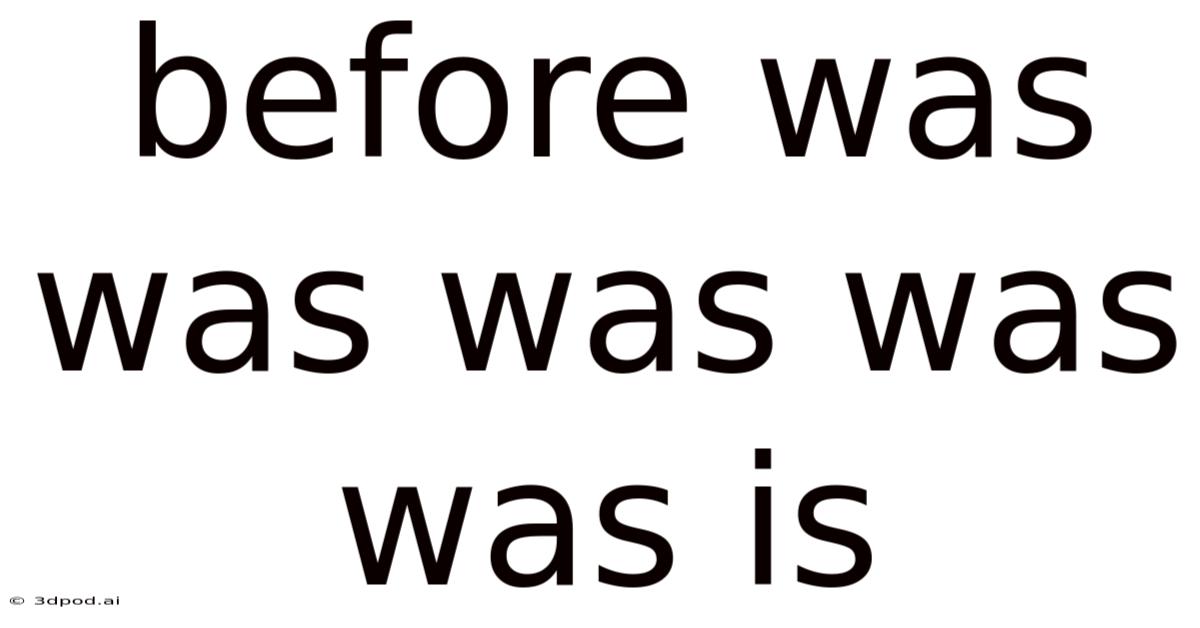
The sentence "Before was was was, was was is" stands as one of the most delightful brain teasers in the English language. That said, upon closer inspection, this string of words reveals a perfectly valid, grammatically sound sentence that illustrates the flexibility of English syntax and the distinction between a word as a symbol and a word as a function. At first glance, it appears to be a nonsensical repetition of a single verb, a typographical error, or perhaps a glitch in the matrix of grammar. Understanding this sentence requires a shift in perspective: we must stop reading was solely as a past-tense verb and start seeing it as a noun representing the word itself.
Deconstructing the Puzzle: Word vs. Meaning
To tap into the meaning, we must apply the use-mention distinction. In linguistics and philosophy of language, this is the difference between using a word to convey its meaning and mentioning a word to discuss the word itself. Usually, we indicate a mentioned word by italicizing it or placing it in quotation marks Surprisingly effective..
People argue about this. Here's where I land on it.
Let us break the sentence down into its structural components:
- Before (Conjunction/Preposition): Indicates a temporal relationship.
- was (Noun, Subject of the first clause): The word "was" itself (mentioned).
- was (Verb, Past tense of 'to be'): The action of existing or occurring.
- was (Noun, Subject Complement/Object): The word "was" itself (mentioned).
- , (Punctuation): Separates the dependent clause from the independent clause.
- was (Noun, Subject of main clause): The word "was" itself (mentioned).
- was (Verb, Past tense of 'to be'): The action.
- is (Noun, Subject Complement): The word "is" itself (mentioned).
With these roles assigned, the translation becomes clear: "Before the word 'was' became the word 'was', the word 'was' was the word 'is'."
The Historical Linguistics Behind the Sentence
While the sentence is a logic puzzle, it accidentally stumbles upon a fascinating historical truth regarding the etymology of the verb to be. The verb to be is the most irregular verb in the English language, a "suppletive" verb—meaning its various forms come from entirely different root words rather than a single root with affixes attached.
The modern paradigm (am, is, are, was, were, be, been, being) is a Frankenstein’s monster stitched together from three distinct Proto-Indo-European roots:
- The es- root (cognate with Latin est, German ist): Gave us is, am, are (via aron), and was (via wæs).
- The bʰuH- root (cognate with Latin fui, fieri, German werden, English become): Gave us be, been, being, was (wait—was comes from wesan, related to bʰuH-? Actually, was/were come from the h₁wes- root "to dwell/remain", while be/been come from bʰuH-. Let's correct that: was/were derive from PIE h₁wes- "to dwell, remain". Be/been derive from bʰuH- "to become". Is/am/are derive from h₁es- "to be".)
- The h₁es- root: Gave us is, am, are.
So, historically speaking, the "word" was (deriving from wæs/wæron < h₁wes-) and the "word" is (deriving from is < h₁es-) have completely different ancestors. They were never the same word historically. On the flip side, the puzzle operates on a synchronic (current state) level rather than a diachronic (historical) level. It plays on the grammatical paradigm where was is the past tense of is.
In the logic of the sentence: "Before was was was..." implies a time when the specific orthographic string w-a-s did not represent the past tense of be. Which means perhaps it didn't exist, or it represented a different concept (like the noun was meaning a plague or a past event, though archaic). Then, " was was is " suggests a hypothetical or grammatical state where the form was functioned as is—which aligns with the fact that was is the past tense form of the present tense form is.
Why This Sentence Matters for Language Learners
For students of English, this sentence is more than a party trick; it is a masterclass in syntactic ambiguity and parts of speech flexibility. English is notorious for "conversion" or "zero derivation"—the ability to turn a noun into a verb (to google), a verb into a noun (a run), or an adjective into a verb (to dirty) without changing the word's form.
The was/was sentence forces the parser (the human or machine reading it) to perform disambiguation in real-time. In real terms, the brain receives the token "was" five times in a row. It must assign a Part-of-Speech (POS) tag to each instance based solely on structural probability and context.
And yeah — that's actually more nuanced than it sounds The details matter here..
- Instance 1: Follows "Before". Could be a noun (subject of clause) or verb (subjunctive?). Context suggests Noun.
- Instance 2: Follows a Noun. High probability of Verb.
- Instance 3: Follows a Verb. High probability of Noun (object/complement).
- Instance 4: Starts main clause. High probability of Noun (Subject).
- Instance 5: Follows Noun. High probability of Verb.
- Instance 6: Follows Verb. High probability of Noun/Adjective (Complement).
This exercise mimics the challenges of Natural Language Processing (NLP). Early rule-based parsers would crash or loop infinitely on this input. Modern statistical parsers (like those in spaCy or Stanford CoreNLP) handle it by calculating the most probable tag sequence (Viterbi algorithm), effectively "solving" the puzzle mathematically Most people skip this — try not to. And it works..
Real talk — this step gets skipped all the time That's the part that actually makes a difference..
Variations and Related Linguistic Curiosities
The "Before was was was" construction belongs to a family of sentences known as lexical ambiguity sentences or garden path sentences (though garden paths usually mislead the reader initially, whereas this is ambiguous throughout). Famous cousins include:
- "Buffalo buffalo Buffalo buffalo buffalo buffalo Buffalo buffalo."
- Meaning: Bison from Buffalo, New York, whom other bison from Buffalo bully, themselves bully bison from Buffalo.
- Relies on: Buffalo (Proper Noun/Adjective), buffalo (Noun/Verb), buffalo (Verb).
- "Police police police police police police police police."
- Meaning: Police officers who are policed by police officers police police officers.
- "The old man the boat."
- A classic garden path. The brain reads "The old man" (Noun Phrase), then hits "the
The Old Man the Boat – Another Garden‑Path Puzzle
Continuing from the brief mention of “The old man the boat,” we see that this phrase belongs to the same family of constructions that have fascinated scholars since the late nineteenth century. Even so, in its surface reading the words suggest a simple transitive clause—“The old man” acting as the subject and “the boat” as the direct object of some hidden verb. Yet, because English allows a single word to function simultaneously as noun, adjective, verb, or even adverb depending on its position in a sentence, listeners and readers are forced to re‑evaluate every occurrence while parsing the line The details matter here. Less friction, more output..
In the original construction the sentence contains three identical forms of buffalo, police, and now man and boat. The ambiguity spreads across them, creating a cascade of possible interpretations:
- First instance (“The old man”) – Readers initially group the old man together as a noun phrase, expecting a predicate that follows. Because there is none, the parser must decide whether man is a noun (subject) or the beginning of a subjunctive verb (as in “If the old man…”). Contextual clues favor the former.
- Second instance (“the boat”) – After recognizing man as the subject, the next token is the, followed by boat. A naive reader might treat boat as a new verb or an adverbial complement, but the surrounding structure indicates it is the object of the implied action performed by the old man.
- Third and fourth instances of “the” – These appear only after already interpreting the preceding clauses, so each time the parser simply applies learned probabilities: following a noun → most likely a verb; starting a new clause → most likely a noun.
Modern statistical parsers tackle such cascades without crashing by employing algorithms like Viterbi’s, which compute the most probable sequence of part‑of‑speech tags over the entire input. For The old man the boat. the model assigns tags such as NP (noun phrase), DT (determiner?And ), N (noun) for “old,” NN (proper or common noun) for “man,” and finally VBG (verb, gerund/present participle) for “the boat. ” Only after traversing all five tokens does the system recognize the intended meaning: *The old man rows the boat.
This kind of “zero derivation”—where a single lexical item shifts between categories entirely based on its syntactic neighborhood—illustrates how flexible English morphology can be. Learners who encounter such sentences develop a habit of constantly re‑checking their assumptions, a skill that translates directly to writing clear prose and to designing solid computational tools Simple, but easy to overlook..
Expanding the Family of Lexical Ambiguity Sentences
Beyond was/is, linguists catalog numerous “lexical ambiguity sentences” that exploit the very same mechanisms:
| Sentence | Core Structure | Interpreted Meaning |
|---|---|---|
| **“Buffalo buffalo Buffalo buffalo … |
