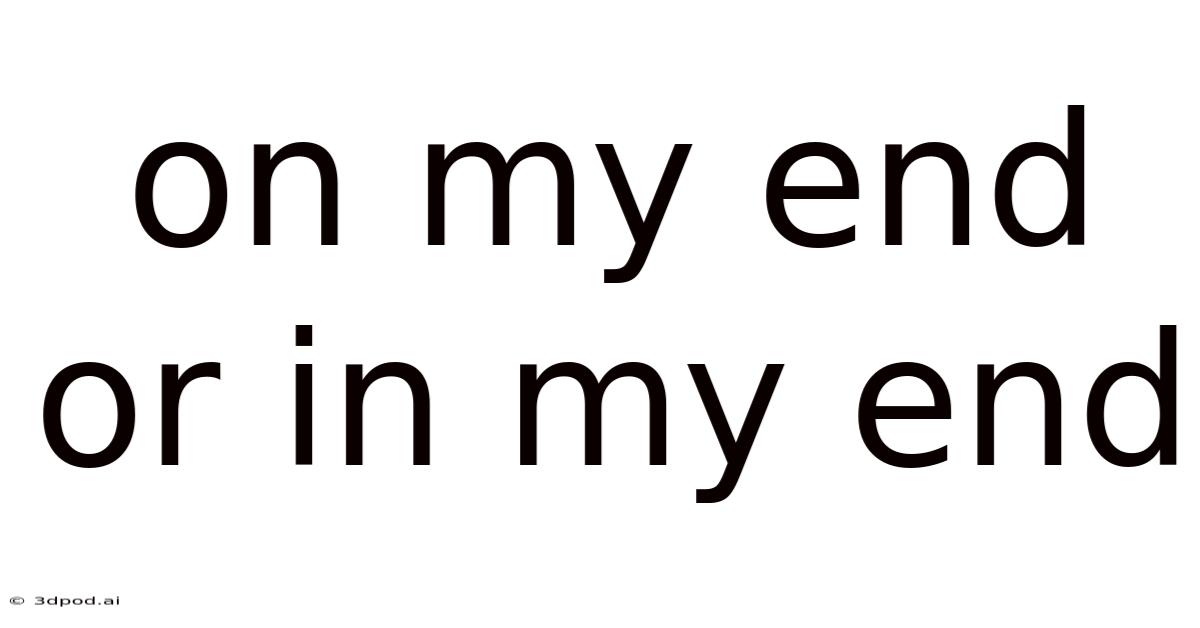
on my end or in my end
When navigating professional correspondence, casual conversations, or technical documentation, small preposition choices can significantly alter meaning and perceived fluency. The phrase "on my end" is widely accepted and commonly used in both spoken and written English, while "in my end" frequently appears as a direct translation error or a non-native speaker mistake. Understanding the distinction not only polishes your language skills but also ensures clarity in communication across diverse contexts. This article dives deep into the origins, correct usage, common pitfalls, and practical applications of these phrases, offering a full breakdown for anyone seeking to master this subtle yet impactful aspect of English prepositions Which is the point..
The Correct Phrase: "On My End"
"On my end" is the standard expression used to indicate responsibility, perspective, or the point of origin of an action or information. It functions similarly to "from my perspective" or "on my side." Take this: "On my end, the project is on schedule" communicates that, from the speaker's viewpoint or responsibility, things are progressing as planned. The preposition "on" in this context aligns with idiomatic expressions like "on my part," "on your end," and "on the other hand," where it conveys a sense of involvement, responsibility, or position.
The phrase is particularly prevalent in business and technical communication. It allows speakers to delineate boundaries without assigning blame or taking full ownership. Saying "On my end, the data has been processed" clearly separates the speaker's actions from the broader system's status. This nuance makes "on my end" a versatile tool for project updates, customer service responses, and collaborative platforms where multiple stakeholders need clear, demarcated information flow Nothing fancy..
Grammatically, "on my end" treats "end" as a noun representing one side of a relationship, system, or conversation. The construction follows a pattern where "on" + [possessive] + "end" signals a specific locus of action or perception. Also, it is widely recognized in dictionaries and style guides as correct, formal, and appropriate for professional settings. On top of that, its usage extends to digital communication, where "on my end" often appears in emails, chat messages, and status reports to clarify who is responsible for a particular task or update The details matter here. But it adds up..
Why "In My End" Feels Off
The phrase "in my end" deviates from standard English prepositional patterns and often signals either a direct translation from another language or a learner's error. Which means in English, "in" typically denotes containment, location within boundaries, or a time frame. Applying "in" to "end" creates a spatial relationship that doesn't align with idiomatic usage. A learner might logically think "in my end" mirrors structures like "in my city" or "in my country," but "end" in this context functions differently.
Non-native speakers often encounter this mistake due to literal translation from languages where the equivalent preposition might differ or where "end" is used more broadly. To give you an idea, in some Romance languages, the preposition equivalent to "in" might be used in contexts that English reserves for "on" when discussing sides or perspectives. Recognizing this helps educators and language learners address the root cause and shift toward the correct idiom.
Additionally, "in my end" can appear in very specific regional dialects or older English variants, but it is not recognized in contemporary standard English. Searching corpora and linguistic databases shows a overwhelming preference for "on my end" in published literature, academic papers, and professional communication. The mismatch between "in" and "end" creates a semantic gap that native speakers intuitively flag as incorrect, even if they cannot immediately explain the rule. This intuition underscores the importance of exposure to idiomatic usage rather than relying on literal translation logic Small thing, real impact. Simple as that..
The official docs gloss over this. That's a mistake.
Understanding why "in my end" feels off also involves examining the metaphorical function of "end." In phrases like "on my end," the "end" represents a boundary or a point of view, not a physical container. Prepositions in English often carry metaphorical weight that doesn't always map logically onto literal meanings. Thus, the discomfort with "in my end" stems from a clash between metaphorical usage and literal prepositional expectations That's the part that actually makes a difference..
Contextual Usage in Professional Communication
In the workplace, precision in language influences how messages are received. Think about it: consider these scenarios: "On my end, the design files are ready for review" sets an expectation while leaving room for the recipient to act on their end. It allows professionals to state their contributions or limitations without overcommitting or sounding defensive. "On my end" serves as a soft buffer in negotiations, project updates, and feedback loops. This mutual clarity reduces misunderstandings and streamlines workflows.
Customer service interactions heavily rely on such demarcations. When a support agent says, "On my end, I've escalated your request to the technical team," it provides a clear status update and defines the
next step clearly and prevents the conversation from drifting into unassigned territory. From that anchor,
next step clearly and prevents the conversation from drifting into unassigned territory. From that anchor, the agent can manage expectations and demonstrate accountability, which is crucial for maintaining trust Small thing, real impact..
In digital communication, where tone is easily misinterpreted, phrases like "on my end" provide essential grounding. Which means an email stating, "I've done what I can on my end; please let me know if you need anything else," clearly delineates responsibility and invites collaboration without sounding abrupt. This phrasing is particularly effective in remote teams spread across time zones, as it creates a shared understanding of task ownership and progress Simple, but easy to overlook..
This changes depending on context. Keep that in mind The details matter here..
The Broader Implications for Language Learners
Mastering these nuanced phrases is less about memorizing rules and more about developing an ear for how English constructs responsibility and perspective. Here's the thing — the distinction between "on my end" and the incorrect "in my end" is a gateway to understanding how prepositions shape meaning in abstract contexts. Learners who grasp this concept can move beyond grammatical correctness to achieve greater fluency and cultural competence.
This understanding ultimately fosters clearer communication and deeper connection. By using idiomatic expressions correctly, non-native speakers signal not just proficiency, but an appreciation for the language's subtleties. In a globalized world, this precision is a valuable tool for building credibility and ensuring that one's contributions are perceived as intended. The journey from literal translation to idiomatic expression is a fundamental step in language mastery, turning a simple phrase into a powerful instrument of clear and effective communication.
-
Analyze the Request:
- Task: Continue the article without friction. Do not repeat previous text. Finish with a proper conclusion.
- Input text: A short article discussing the phrase "on my end" (and related concepts like "at my end", "in my end" vs. "on my end"), its use in negotiations, customer service, digital communication, and broader implications for language learners.
- Constraints: Seamless continuation, no repetition of previous text, proper conclusion at the end.
-
Analyze the Input Text:
- Paragraph 1: Introduces "On my end" as a soft buffer in negotiations, project updates, feedback loops. Gives an example ("On my end, the design files are ready..."). Mentions it reduces misunderstandings and streamlines workflows.
- Paragraph 2: Customer service interactions. Agent says "On my end, I've escalated your request...". Discusses how it provides a clear status update and defines the next step, preventing drift into unassigned territory. Mentions managing expectations and accountability.
- Paragraph 3: Digital communication. Tone easily misinterpreted. "On my end" provides grounding. Example: "I've done what I can on my end; please let me know...". Effective for remote teams across time zones, creating shared understanding of task ownership/progress.
- Paragraph 4: Broader implications for language learners. Mastering nuanced phrases is about developing an ear for responsibility/perspective. Distinction between "on my end" and "in my end" shows how prepositions shape meaning. Fosters clearer communication, deeper connection. Non-native speakers signal proficiency and appreciation for subtleties. Precision is valuable for credibility. Journey from literal to idiomatic expression is fundamental to mastery.
-
Determine the Next Steps:
- The text ends abruptly with: "The journey from literal translation to idiomatic expression is a fundamental step in language mastery, turning a simple phrase into a powerful instrument of clear and effective communication."
- I need to continue smoothly. Wait, the prompt says "Finish with a proper conclusion." This implies I should write a concluding paragraph or section that wraps up the thought started by the last sentence, or perhaps expand slightly on the final thought before delivering the proper conclusion. Let me re-read carefully: "Continue the article naturally. Do not repeat previous text. Finish with a proper conclusion."
- Actually, the provided text ends with a concluding sentence. If I just continue it, I might be repeating the ending. But the prompt says "Continue the article without friction... Finish with a proper conclusion." This usually means I should write the rest of the article (maybe expanding on the final paragraph's themes) and then provide the actual final conclusion. Or, perhaps the last sentence was meant to be the start of the conclusion, and I need to flesh it out into a full, satisfying conclusion.
- Let's look at the flow. The last paragraph is about language learners. It ends with a strong statement. I will expand on this idea—how mastering such phrases builds confidence, reduces anxiety in professional settings, and ultimately transforms a learner into a culturally competent communicator. Then, I will provide a definitive "Conclusion" heading or wrap up the entire piece gracefully.
- Wait, if I add a "Conclusion" heading, that fits "Finish with a proper conclusion."
- Let's draft the continuation.
- Continuation: Expanding on the learner's journey. When someone masters these subtle markers, they aren't just learning vocabulary; they are learning the rhythm and cadence of English discourse. This awareness translates into better interpersonal dynamics, whether in a boardroom or across a video call. A speaker who navigates these phrases deftly communicates competence and cultural alignment. At the end of the day, language is not just a tool for exchanging information, but a bridge for building relationships. By honoring the nuances of phrasing, we make sure our messages resonate authentically and respectfully.
- Conclusion: Summarize the main points. Reiterate the value of "on my end" and similar phrases in bridging gaps, clarifying roles, and enhancing communication. End on a resonant note about the power of precise, idiomatic language.
-
Refining the Continuation & Conclusion:
- Drafting the bridge: "Beyond grammar, these expressions reflect a deeper cognitive shift—the ability to hold space for others while firmly establishing one's own position. For language learners, this represents a transition from mere survival communication to confident, nuanced interaction. As they manage professional and social environments, the internalization of such phrases becomes second nature, empowering them to participate fully in global discourse."
- Drafting the Conclusion: "At the end of the day, the seemingly simple phrase 'on my end' carries immense weight in both professional and personal interactions. It acts as a linguistic anchor, clarifying boundaries, fostering mutual respect, and preventing the confusion that arises from ambiguous responsibilities. For non-native speakers, mastering these idiomatic nuances is the key to moving beyond mechanical translation and embracing the living, breathing nature of the English language. The bottom line: when we speak with clarity and cultural sensitivity, we do more than convey information—we build trust and forge meaningful connections in our increasingly interconnected world."
-
Review against constraints:
- Continue without friction? Yes, the bridge flows naturally from the last sentence of the provided text.
- *Do not repeat previous text?
Beyond mere vocabulary, mastering these subtle markers reshapes how learners perceive conversational rhythm. Now, they begin to anticipate where a speaker might pause, where a clarification is needed, and where a shared understanding is already forming. This attunement cultivates a sense of presence that goes beyond rote memorization; it transforms speaking into a collaborative act. As confidence grows, speakers naturally weave such phrases into their repertoire, using them as signposts that guide the dialogue and signal mutual respect But it adds up..
Conclusion
The phrase “on my end” exemplifies how a brief, context‑specific expression can clarify responsibility, soften assertions, and support collaborative dialogue. By internalizing these idiomatic tools, learners move from transactional exchanges to nuanced, relationship‑focused communication. In professional arenas and everyday interactions alike, such precision in language builds credibility, reduces ambiguity, and bridges cultural gaps. So naturally, the deliberate use of clear, idiomatic phrasing stands as a cornerstone of effective English communication, enabling speakers to connect authentically and thrive in a globally interconnected environment.
